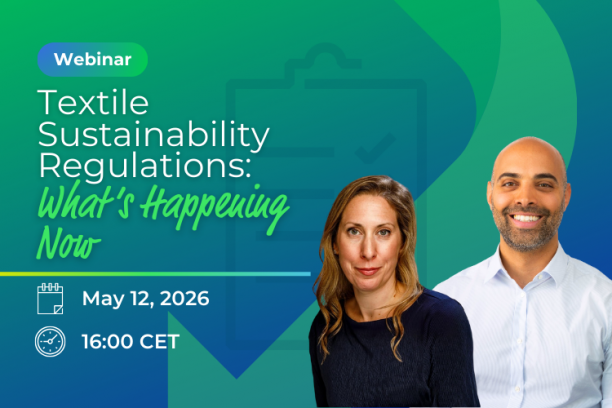
Overview
The Ecodesign for Sustainable Products Regulation (ESPR), in force since July 2024, is reshaping how products must be designed, made, circulated, and managed across the EU. As one of the most far-reaching sustainability regulations ever implemented, ESPR will significantly impact textile brands and retailers affecting product design, supply chains, materials, after-use pathways, and data disclosure requirements.
Crucially, ESPR will also directly shape textile Extended Producer Responsibility (EPR). Eco-design criteria developed under ESPR are expected to become the basis for eco-modulation of EPR fees, while data generated for EPR compliance is increasingly likely to be required within Digital Product Passports (DPPs).
This webinar will give you a clear, practical view of how ESPR and EPR are converging and what this means for textile businesses operating in the EU.
What You’ll Learn
- What ESPR is and why it matters for textiles – Understand the regulation’s objectives and its link to the EU’s Circular Economy Action Plan.
- Key eco-design requirements relevant to textile products – Including durability, recyclability, repairability, recycled content, hazardous substances, and waste minimization.
- How ESPR eco-design criteria are likely to define fee modulation under textile EPR schemes across Member States
- How Digital Product Passport (DPP) requirements will transform transparency, traceability, and data management for textiles.
- Rules on destruction of unsold goods – What brands need to change in their operational and stock management practices.
- Implementation timelines & upcoming delegated acts – What to expect from the 2025–2027 Working Plan and upcoming product-specific rules.
- How to prepare strategically – Actions brands and retailers can start taking now to future-proof their portfolios, supply chains, and compliance frameworks.
Why Attend?
Textiles are among the priority sectors under ESPR, and early preparation will determine competitive advantage. The regulation will:
- Reshape design and material decisions
- Influence procurement and supplier requirements
- Impact reuse, repair, recycling and end-of-life obligations
- Increase data and traceability expectations across the value chain
- Strengthen alignment between ESPR, EPR and Digital Product Passports through eco-design and data
Whether you’re leading sustainability, product development, compliance, sourcing or circularity initiatives, this webinar will equip you with actionable insights.
Who Should Attend
- Apparel Brands and Retailers (global and EU)
- Sustainability and ESG teams
- Product and design teams
- Regulatory, compliance and legal teams
- Circularity & EPR program leads
- Supply chain and operations managers
Meet the experts

Aimee Campanella - Development Director - Textiles EPR
Aimee specialises in guiding clients through the intricate landscape of global legislation surrounding textiles EPR. Ensuring compliance with these regulations isn’t just a priority, it’s a legal requirement. Aimee is passionate about driving reuse initiatives through Reconomy’s omnichannel network. By leveraging Reconomy’s extensive resources, Aimee helps clients not only meet their regulatory obligations but also explore sustainable, environmentally friendly practices that benefit both their business and the planet.

Lavi Aharon - Director of Textile Program and Business Development
Lavi has deep expertise in environmental economics, circular materials management, and textile value chains. He currently serves as Director of Textile Program & Business Development at Reconomy, where he advances strategies for Extended Producer Responsibility (EPR) and circular textile systems. As Textile EPR gains momentum globally, Lavi is passionate about helping textile brands move beyond being compliant to a more strategic and meaningful circular approach.
Register Now
Secure your place and learn what your organization must do to comply with, or lead under, the new eco-design regime.
We look forward to helping you navigate the next phase of sustainable product regulation.